
While the digital marketing world has undergone a radical transformation over the past decade, the fundamentals remain: the core challenge is still moving consumers from not knowing which brand to choose to picking your brand.
As AI-driven discovery contracts the research phase, brands must find new ways to secure attention and ensure they are cited as the primary choice in this mid-funnel (the consideration and evaluation stage of the buying journey, before purchase).
Back in 2016, the focus was on big data and the early days of programmatic advertising. We watched the explosion of influencer marketing and the meteoric rise of TikTok. Fast forward to 2026, and the conversation has shifted entirely towards generative AI, shoppable video and generative engine optimisation (GEO).
For brands to stay relevant today, they must move beyond traditional tactics such as running non-skippable YouTube pre-rolls, building keyword-focused SEO strategies simply to rank first in search results, and running retargeting ads with the sole aim of conversion.
To capture attention, brands need to look past the “obligatory awareness campaign” and rush to convert consumers by owning the mid-funnel – the consideration phase where key decisions are made. Google calls this point in the consumer journey the “messy middle”.
Why is the middle messy?
The middle of the funnel is where key decisions are made. At this stage, the consumer knows you exist but isn’t quite sure your product or service is right for them. So, what do they do? They search for competitors, ask friends, scrutinise benefits and actively seek better deals. They want the product and are ready to buy, but aren’t yet convinced that your brand is the right choice.
This is where most brands lose the consumer. They have seen your brand and liked your social media posts, but you haven’t done enough to convince them to choose your product. There are many decision-making moments during this (messy middle) phase. If a brand doesn’t prioritise this step and rushes straight to the conversion phase, it misses out on converting someone who is interested but not yet convinced.
The shrinking window: why traditional search is losing ground
Trends have come and gone over the years, but Google’s “ZMOT” concept remains as relevant as ever. ZMOT – or zero moment of truth – explains the need for brands to communicate with consumers during the critical research phase of the buying journey, when people are actively searching for a service but haven’t yet picked a provider.
However, this research phase is shrinking – people are moving away from traditional search on Google or Bing and using tools like ChatGPT, Gemini or Google AI Overviews to get instant answers. In 2024, it was projected that traditional search engine volumes would drop 25% by 2026. This means far fewer people are scrolling to the second or third page of search results; they are getting synthesised research immediately, which effectively reduces the ZMOT window.
But the marketing funnel isn’t dying; it’s accelerating! While the fundamentals of moving a consumer from awareness to action remain, the way brands compete for that attention has shifted. In 2026, the messy middle has been replaced by high-speed AI synthesis, where traditional search is declining and “brand citations” are the new currency.
To stay relevant, brands must stop interrupting and start integrating. But how do they do this?
1. Winning the zero moment of truth in an AI world
While ZMOT remains the ultimate digital marketing battleground, in 2026 AI often handles the heavy lifting for consumers. We have entered a phase that entrepreneur Jason Barnard terms the “zero-sum moment”: if an AI assistant summarises a market or answers a question and doesn’t mention your brand, you effectively don’t exist for the customer.
To win here, brands must:
- Be answer-ready: data shows that up to 40% of young users now prefer using TikTok or AI tools over Google Search for discovery. This means consumers are increasingly looking for answers within the platforms they are already using, rather than turning to traditional search engines as they did in the past
- Prioritise social proof: in 2026, a brand’s own claims are ”noise” while a recommendation from a stranger is ”truth”. User-generated content currently delivers a four-times-higher click-through rate (CTR) than standard ads, because consumers trust peers over corporations
- Optimise for speed: if your site or chatbot can’t provide an instant answer, users bounce. In a world of instant AI gratification, a three-second delay is an eternity
2. The rise of generative engine optimisation
While critics have for years claimed that SEO is dying – some trackers note nearly 5 000 such declarations since 2016 – the industry is actually evolving into GEO. This is the process of tailoring content so it is cited, summarised and recommended by AI-driven systems.
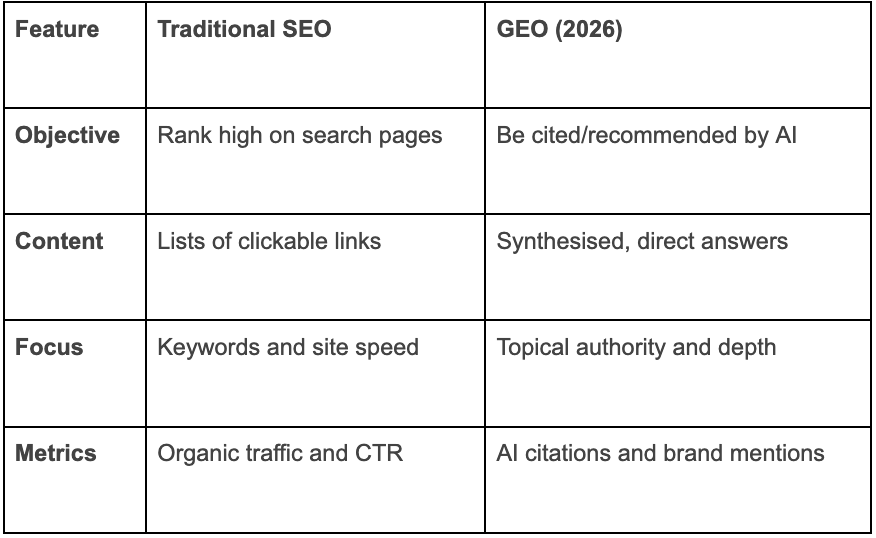
Research into AI engine visibility suggests that authoritative, data-backed citations increase the likelihood of being featured in AI summaries by 37%.
3. Shoppable video: converting impulse into action
Social commerce has peaked with the dominance of shoppable video – interactive content with embedded, clickable tags. This means consumers can buy a product in real time by simply clicking on an image they like.
For example, in a video of a celebrity wearing a certain outfit that goes viral, consumers can click on the image to see the price of each item. A single tap then drives them directly to a store where they can buy that specific item. This is a direct response to Gen Z’s habits, as this group is roughly twice as likely to make an impulse purchase as the general population.
The benefits are clear:
- Higher conversions: by removing steps in the buying journey – such as identifying the product, searching for it online and creating an account – brands can capitalise on the “impulse” phase
- Reduced friction: users add to their shopping cart without ever leaving the video. Industry data indicates that shoppable video ads see a 30% higher conversion rate than traditional display ads
- Platform integration: tools like Instagram Reels, TikTok (linked to Shopify) and YouTube offer seamless checkout that keeps users in their flow
4. Ads within the AI interface

We are moving towards a future where ads are integrated directly into conversational AI platforms. Imagine asking a chatbot to plan a trip to Tokyo and receiving a “sponsored tool” suggestion for a travel booking site offering a specific discount for your destination.
This isn’t an interruption; it’s a utility. Early testing of in-chat sponsored content shows significantly higher engagement than traditional banner ads because the “ad” is actually the solution to the user’s current problem.
Final thoughts
In 2026, visibility isn’t just about being found; it’s about being referenced. Whether through shoppable video or GEO, the brands that thrive will be those that prioritise clarity, authority and seamless user experiences in an AI-first world. The consideration phase has shrunk; if you aren’t there the moment the question is asked, you’ve already lost the sale.